
Route the Query, Not the Data
Last week Stripe confirmed it is buying OpenRouter for a reported $7.5 billion. In May, OpenRouter was valued at $1.3 billion.
Last week Stripe confirmed it is buying OpenRouter for a reported $7.5 billion. In May, OpenRouter was valued at $1.3 billion. That is the price moving almost six times in about ninety days, for a company that owns no models, trains nothing, and runs no proprietary intelligence of its own.
What OpenRouter owns is the routing layer. It sits between more than ten million developers and 400 plus models from over 80 providers, takes each request, and sends it to the model best suited to answer it on price, performance, and availability. Stripe reportedly had to outbid Databricks to get it.
Think about what that price says. In a market full of capable providers, the layer that decides where each request goes became more valuable than most of the providers themselves.
We think the same thing is about to happen in business data.
What OpenRouter proved
Three years ago, building with AI meant integrating model providers one at a time. Different APIs, different billing, different failure modes. OpenRouter collapsed all of it into one interface and a live decision: for this request, right now, which model should answer?
The lesson generalizes past models. When capability is spread across many systems, integration is the wrong abstraction. Routing is the right one.
Business data has the same shape
Ask a real business question. What did we ship to this customer last quarter, at what margin, against what forecast, and with which support tickets still open? The answer lives in four systems: an ERP, a CRM, a planning tool, a ticketing platform. Each one holds a piece. None holds the answer.
For forty years the industry's response has been the opposite of routing. Copy everything into one place first, then ask. Warehouses, lakes, pipelines, ETL. Move the data to the question.
The bill for that approach is enormous and mostly invisible. IDC has estimated that for every unique piece of enterprise data, roughly nine copies exist. Call it 90 percent. Ninety percent of what companies store, secure, back up, and govern is a duplicate of something they already have. And every copy costs you twice: once in infrastructure, and once in trust, because a copy is only as fresh as the last pipeline run.
We copied for a reason. Decades ago, networks and compute could not execute a question across live systems fast enough, so centralizing was the workaround. The constraint died. The workaround became the industry.
Route the query, not the data
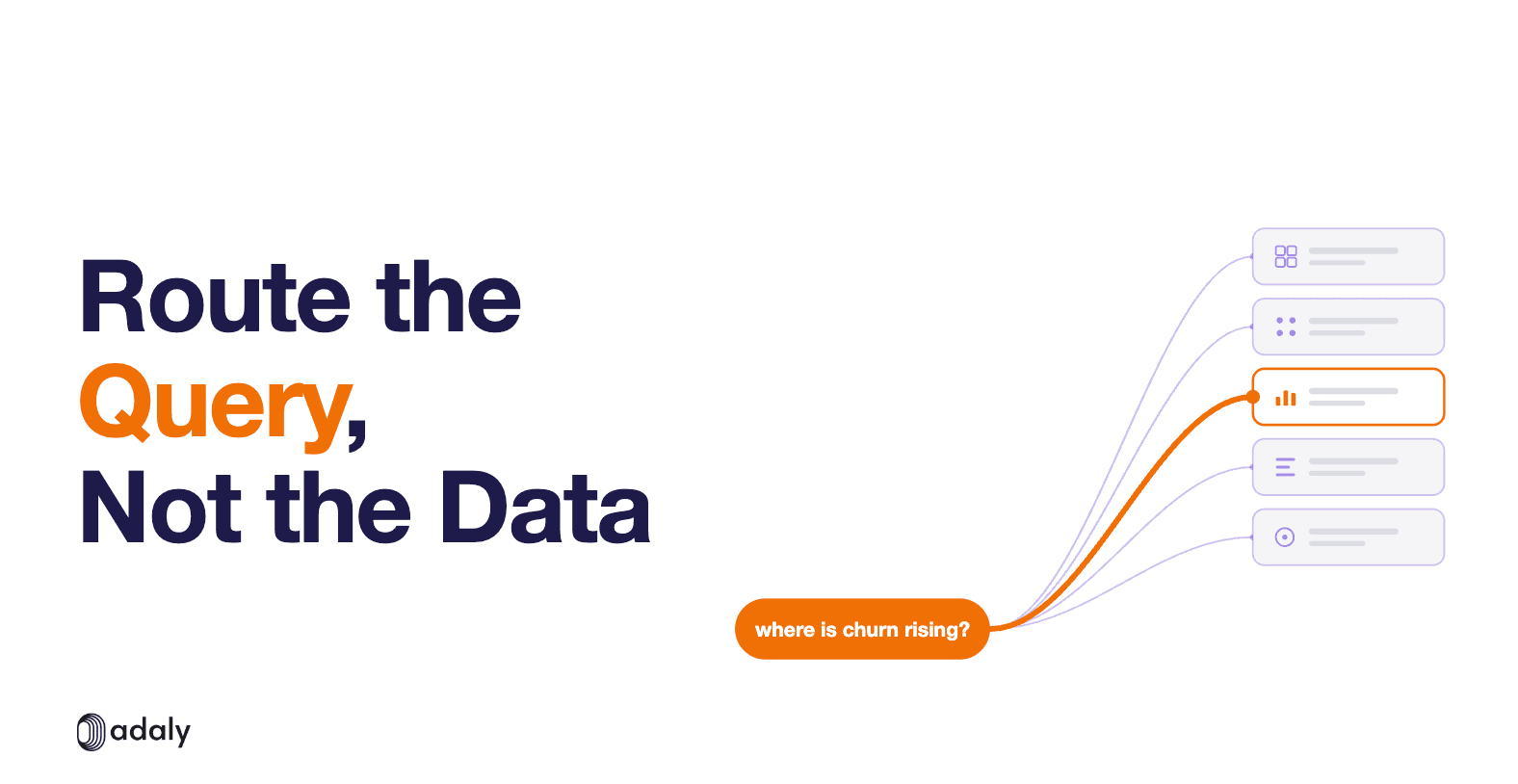
Adaly applies the OpenRouter posture to business data. A question comes in. It gets routed to the systems that hold the answer. The work executes inside those systems, under their permissions. The results compose into one response and return live. Nothing gets copied into a warehouse first. Nothing moves at all.
Where the analogy breaks
Here is the part worth being honest about: routing data is harder than routing models.
Model routing chooses among interchangeable options. A dozen models can summarize your document, so the router shops on price and speed. Data routing has no substitutes. The answer to that shipment question lives in one specific system, behind specific permissions, in a specific schema. The router cannot shop around. It has to know exactly where the answer lives and how to get it right.
Which is why surface-level connectors fail at this job. An API stub that lists records cannot answer questions. Routing works only when the connector goes to full depth in every source: schema, semantics, permissions, read and write. Anything shallower is middleware sitting on top of the copy problem. It adds cost instead of removing it.
Routing is governance, too
The question hanging over the Stripe deal is neutrality. Can a router owned by a payments giant still put the user first? Inside an enterprise, the parallel question is control, and routing answers it better than copying ever has.
A routed architecture gives you one conduit and one audit trail. Who asked, what they asked, which systems answered, under whose permissions. Compare that to governing fifteen pipelines and four copies of the same customer record, each with access rules drifting out of sync. Copies multiply your governance problem. Routing collapses it.
Agents made this urgent
Stripe's logic for the deal is that tokens are becoming a core currency of business, and agents will be spending them at enormous scale. Take that logic one more step. An agent that reasons in seconds cannot wait for a pipeline that runs overnight. When it needs to know what is in stock, what the contract says, or what the customer bought, it has to find where the answer lives and open a governed conduit to it immediately.
Agents do not need a bigger warehouse. They need a router.
Efficient and effective
The whole case fits in two words. Efficient: nothing moves, nothing is stored twice, no pipelines to maintain, no copy tax. Effective: answers composed live from the systems of record, not from last night's snapshot.
The market just paid $7.5 billion for the routing layer for AI models. The routing layer for business data is the bigger prize, because the questions that run companies are worth more than the tokens that answer them.
Stop copying. Start connecting.