
Shadow AI Is What Happens When the Sanctioned Path Is Too Slow
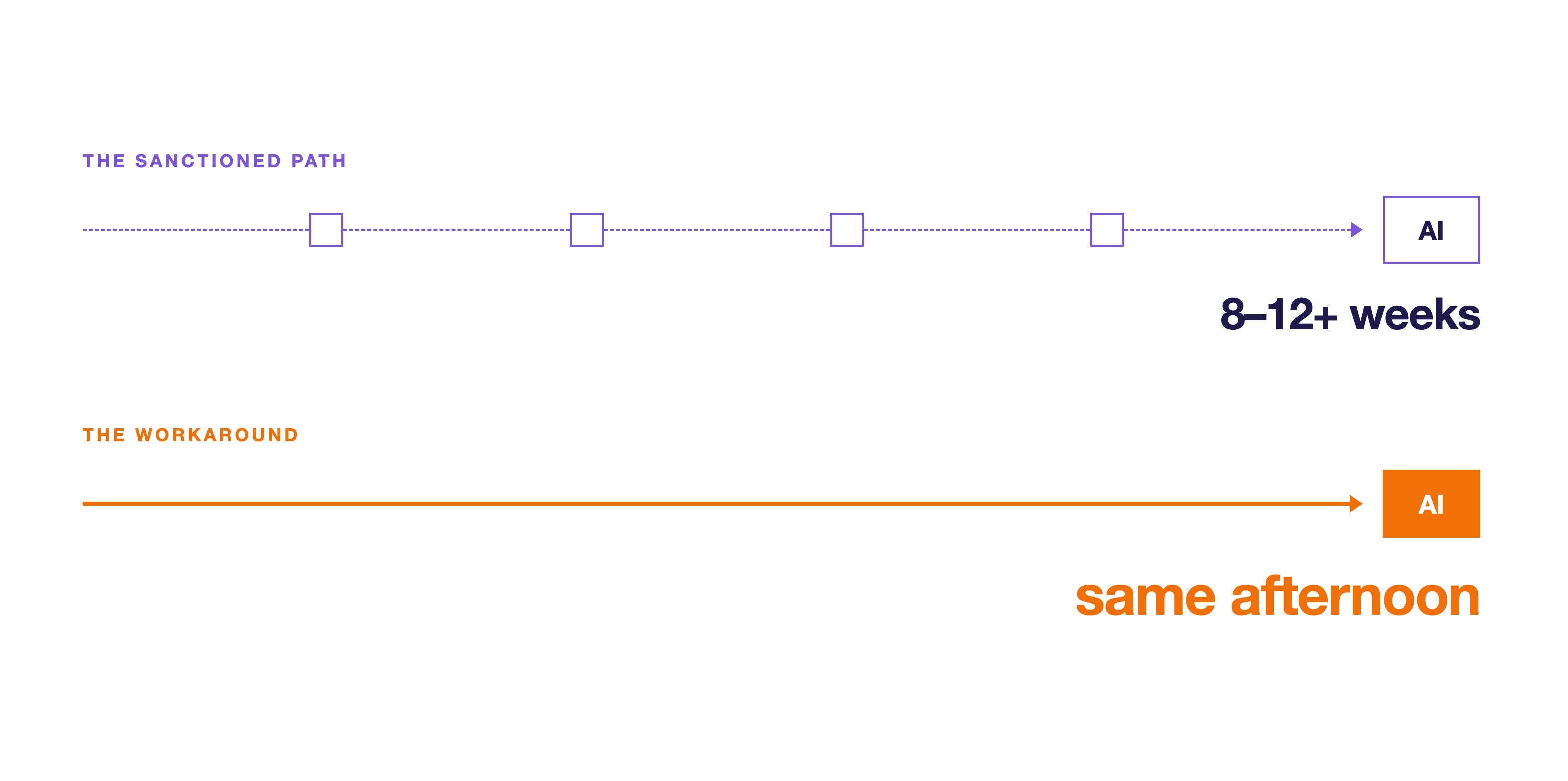
Shadow AI wins because the sanctioned path is still too slow.
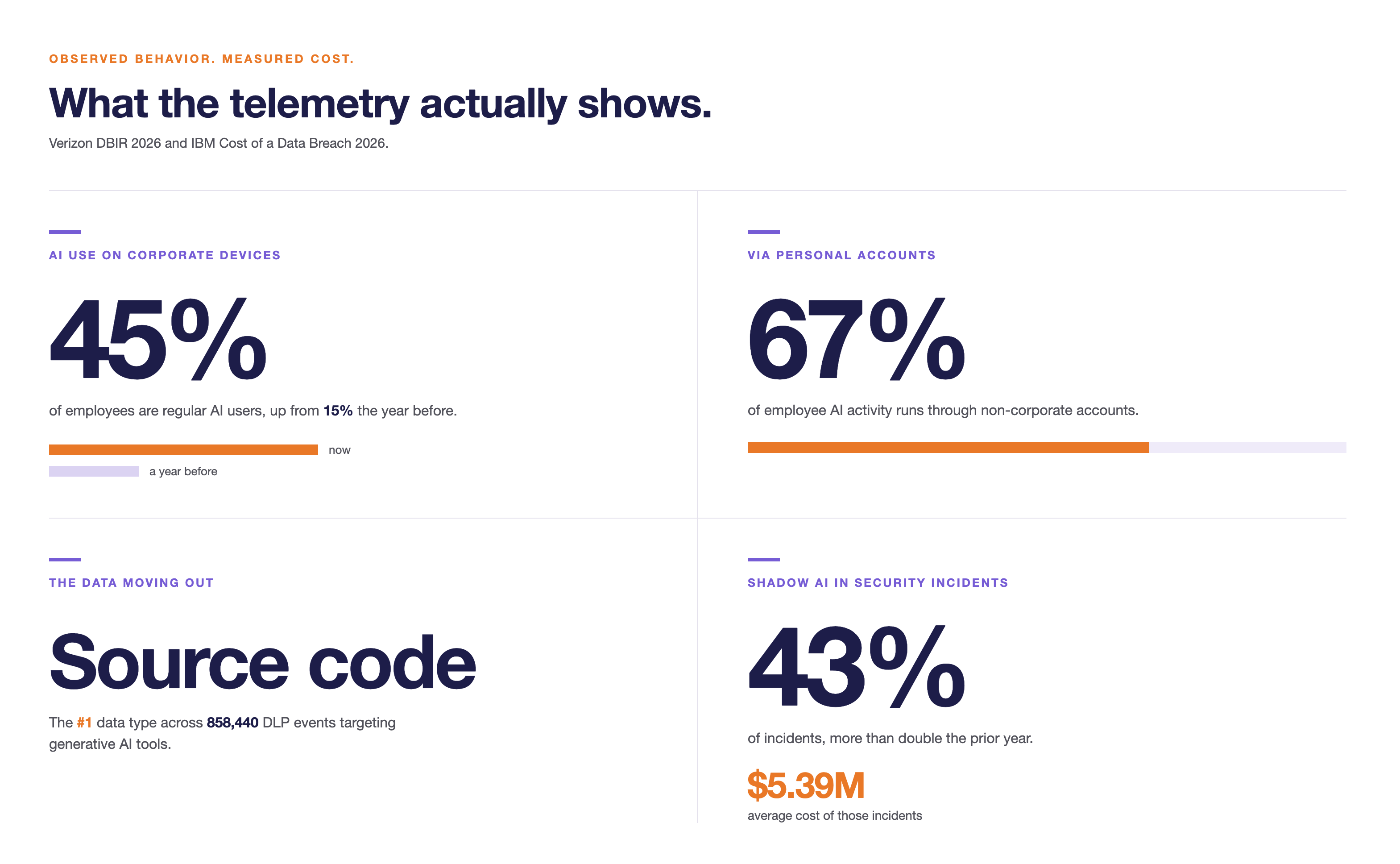
Verizon’s 2026 Data Breach Investigations Report looked at real DLP events, not opinions. 45% of employees are now regular users of AI on corporate devices, up from 15% the year before. 67% of that activity runs through non-corporate accounts. Shadow AI is the third most common non-malicious insider action in their dataset, a fourfold increase. Across 858,440 events targeting generative AI tools, the most common data type moving into ungoverned systems is source code.
IBM’s Cost of a Data Breach report for 2026 shows the financial side. Shadow AI showed up in 43% of security incidents, more than double the prior year. Those incidents averaged $5.39 million. Approval discipline is moving the wrong way: only 38% of organizations required IT approval before AI deployment, down from 45%.
These are not soft survey answers. This is observed behavior and measured cost.
Most coverage still treats this as a policy or awareness problem. It is not. People know the risks. Three in four employees acknowledge the security or privacy issues and use the tools anyway. Nearly two-thirds of senior decision-makers admit to unapproved AI tools, roughly double the rate of lower-level employees. When leadership does it, the culture follows.
The cleanest explanation I have seen comes from Nik Kale, principal engineer at Cisco: people are not going around the front door because it is locked. They are going around it because the front door is slower.
Teramind data makes the point sharper. Roughly two-thirds of enterprise AI activity runs through personal accounts on platforms the company already licenses. We are paying for the governed version and still watching people use the ungoverned one of the same product. The tool is not the bottleneck. Time to useful access is the bottleneck.
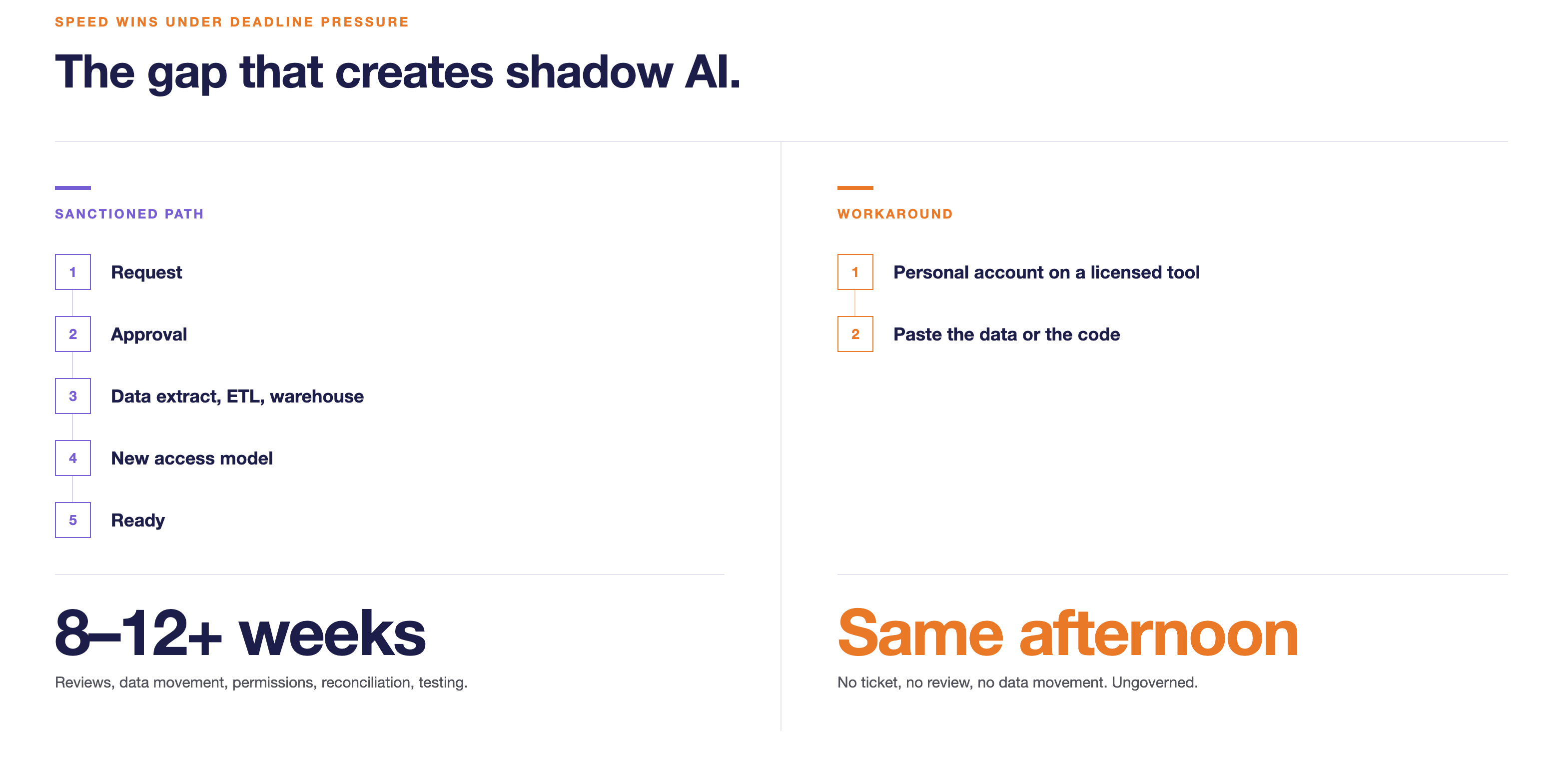
A sanctioned request for real access to systems and data usually means a ticket, a review, data movement into a warehouse or approved environment, new permissions, reconciliation, testing. That can take a quarter. Someone who needs an answer this week opens a personal account and pastes the code or the table. Afternoon versus a quarter. Three weeks of quiet experimentation versus three quarters of process. Speed wins under deadline pressure.
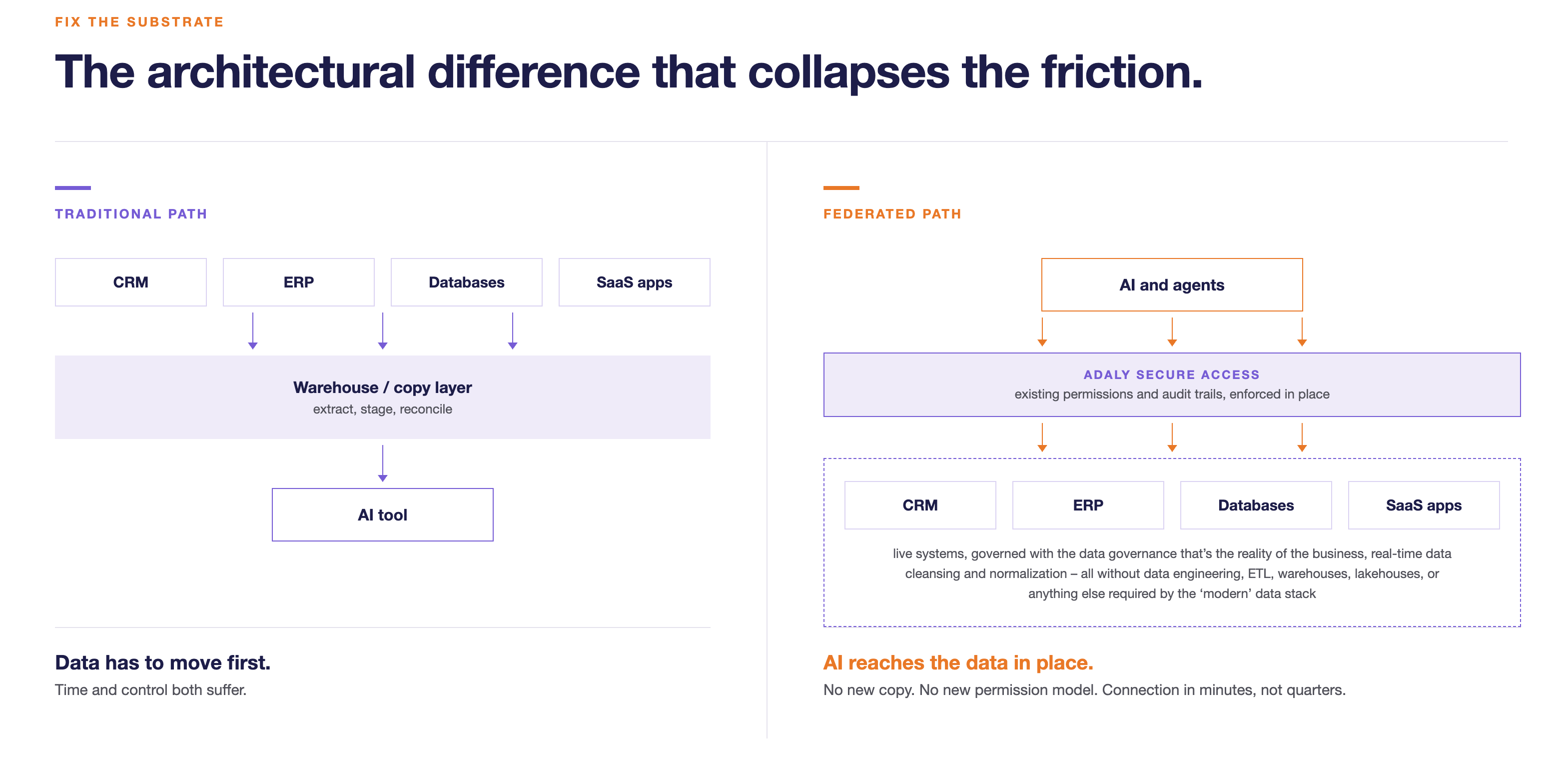
This is the architecture tax of the modern data stack. Intelligence is treated as something that can only happen after data has been copied, staged, and reconciled into a new place. That process is slow by design. It is also why governance and speed keep ending up in conflict.
The accountability numbers make the tension structural. IBM Institute for Business Value found two-thirds of CIOs and CTOs are held accountable for AI systems they do not fully control. 70% say technology is being deployed faster than IT can track. 77% say AI adoption is outpacing governance. Only 11% feel fully prepared for the agent scale coming, while most face CEO mandates to accelerate. Experimentation has been decentralized far faster than accountability.
And the next wave is already moving past chatbots. Shadow AI is expanding into agents and MCP servers that can act: query a database, write to a repo, with whatever credentials someone handed them. A leaked document is one problem. A rogue agent with write access is another order of magnitude.
Most of the advice still lands on discovery tools, tighter policies, and better sanctioned options. Those help. Almost nobody asks why the sanctioned path is slow in the first place.
The sanctioned path is slow because it usually requires moving data into a new place before anyone can use it. That is the modern data stack tax. What a governed fast path actually requires is different architecture. Let the models and agents reach the live systems where the data already lives, under the permissions and audit trails that already exist. No new copy. No new permission model. No multi-month project before the first useful query. Connection in minutes or weeks instead of quarters.
When the approved path is as fast and as capable as the workaround, the workaround stops being the rational choice. There is already evidence this works. One healthcare system that provided proper approved tools saw an 89% reduction in unauthorized AI use and 32 minutes of daily time savings per clinician. Shadow AI is a demand signal. Channel it properly and you get both the productivity and the oversight.
This is the architecture we built Adaly around. Live data in place across the systems you already run. Existing controls stay in force. The modern data stack created the delay. We collapsed it.
Fix the substrate that forces the choice between speed and governance, and the behavior follows. The alternative is watching the gap keep growing while the agents get more autonomous.