
Everything we’ve said.Everything said back.
Dispatches out, echoes in. Press releases, founders letters, thought leadership, and podcasts on one side of the wire; what the world printed back on the other. Newest first, every word on the record.

The Capital War Behind AI Winners and Losers
There's a war happening and those that see it will win while those who don't will be blindsided by it.
The AI race is not being won on models.
The AI race is not being won on models. Everyone can buy the same models. Your competitor can call the same API you can or download the same open source model and tune it.
This a race that's going to be won on capital. Which company in the competitive set is going to outspend the other and make the economics work better with AI? That's who's going to win.
Start with what you already pay
Most companies run their data programs at somewhere between 2 and 6 percent of operating expense. Technical companies sit at the top of that range. Zoom out to total IT and the 2026 benchmark is about 5.7% of revenue across all industries, with financial services at 7% to 10% and manufacturing down at 2% to 5%. Those figures come from Gartner IT Key Metrics, Avasant, and IDC.
Now look at what that money actually buys.
Fivetran and dbt Labs both published in April 2026 and landed on the same number from different angles: 53% of enterprise data engineering time goes to maintaining pipelines that already exist. For organizations running more than 200 active pipelines, it is 61%. Fivetran's benchmark puts average annual pipeline maintenance labor at roughly $2.2 million per enterprise.
Half your data team is not building anything. They are keeping copies of your own data in sync with your own data.
Flexera's 2026 State of the Cloud Report puts wasted cloud spend at 29 percent of IaaS and PaaS, the first increase in five years. They surveyed 753 cloud decision makers. Seventy-six percent of large enterprises now spend more than $5 million a month on public cloud. Twenty-nine percent of that is money nobody can account for.
And underneath all of it sits the number I keep coming back to. IDC has tracked the ratio of unique data to replicated data for years. It was 1 to 9 in 2020 and projected to hit 1 to 10. Roughly 90% of the data in the world is a copy of something else.
You are paying to store it. You are paying to move it. You are paying people to keep it from drifting. You are paying again when it drifts anyway and someone makes a decision on a stale number.
That is the bill you already signed.
Now the bill you have not seen
Gartner forecasts worldwide AI spending at about $2.59 trillion in 2026, up 47% year over year. That is the macro number and it is easy to ignore because it is not yours.
The average enterprise AI budget went from $1.2 million a year in 2024 to $7 million in 2026. Inference, meaning the cost of actually running models against live data, now accounts for 80% to 90% of enterprise AI spend, up from around 20% in 2023. Stanford HAI measured a 280 fold drop in the cost per unit of inference over two years. Bills went up anyway, because consumption grew faster than price fell.
KPMG's Global AI Pulse found 49% of organizations have already delayed or scaled back AI work because of cost. Flexera's 2026 ITAM report found 59% saying wasted AI spend rose year over year. Zylo found 78% of IT leaders hit unexpected charges from consumption based pricing. Deloitte is reporting enterprises with monthly AI bills in the tens of millions.
If your plan is to host open source on prem and avoid this, run the numbers again. You are still buying GPUs. You are still paying for power and cooling. You are still hiring people to run it. You moved the line item. You did not delete it.
So here is the position most companies are in right now. A data program that consumes single digit percentages of opex and delivers a fraction of what it costs. On top of that, an AI bill that is variable, hard to forecast, and growing faster than anything else on the table. And no new money to pay for it.
Something has to give. Right now what gives is AI ambition.
The gears are grinding and the fix is more gears
This is the part I personally find hardest to watch.
Companies know their data infrastructure is the bottleneck. They know AI stalls at the integration layer. Deloitte's 2026 enterprise AI report says it plainly: legacy data architectures cannot support real time autonomous AI.
So what do they do? They spend more on the data architecture. More pipelines. More warehouse compute. More middleware to connect the middleware. A FinOps team to watch the spend, and then a tool to watch the FinOps team.
Every dollar of that is spent optimizing a system that
should not exist in the first place.
The warehouse made sense when networks were slow, compute was expensive, and querying a production system meant taking it down. Those constraints are gone. They have been gone for a while. What remains is a habit with a budget line, and an entire vendor ecosystem that gets paid to keep the habit alive.
MIT's NANDA report on 300 public AI deployments found that 95% of enterprise GenAI pilots produced no measurable P&L impact, against $30 to $40 billion in spend. The authors were specific about why. It was not model quality and it was not regulation. It was integration. Top performers shipped in 90 days. Enterprises took nine months or more.
People argue about that study's methodology, and fine, argue about whether it is 95 or 70. The direction is not in dispute. Companies are failing at AI because their data cannot get where it needs to go, and they are responding by pouring more money into the machinery that is blocking it.
Spend less on data. Get more out of it.
I know how that sounds the first time a CFO hears it.
Data is the constraint on AI. Everyone agrees. So the obvious response is to invest more in data. Better pipelines, faster warehouse, another integration platform. It feels responsible. It survives every budget review, because nobody ever got fired for strengthening the foundation.
It is also backwards, and the reason is worth sitting with.
That money never reaches your data. It goes into the friction around your data. Pipelines exist because the data is in the wrong place. Warehouse compute exists because you made a copy. Integration labor exists because the copy drifted. Reconciliation exists because two copies disagree. None of that work touches the thing your business runs on. It maintains the machinery you built to move the thing around.
So the budget is flowing directly into the point where AI stalls, and it makes the stall worse, because every dollar adds another layer of copying between a model and a fact.
Cut it and two things happen at the same time. The line item shrinks. The friction disappears, because a model can now reach a live system instead of interrogating a warehouse full of yesterday.
Then put the freed money into AI. That is where the disproportion comes from. You remove the constraint and fund the thing the constraint was holding back, with the same dollars, inside the same budget cycle. One move, two effects, and they multiply against each other.
Why it shows up everywhere at once
This does not land in one department. Federated access changes what every function is able to ask for.
Manufacturing gets line telemetry, quality results, and supplier lead times in a single query, so a model can catch a defect pattern against a specific batch from a specific vendor while the run is still going.
Supply chain stops planning against last night's snapshot and starts planning against inventory, open orders, and logistics as they stand right now.
Product development gets usage telemetry sitting next to support tickets sitting next to revenue by account. Most companies own all three and can join none of them in a useful timeframe.
Analytics gets its year back. Fivetran and dbt Labs both put pipeline maintenance at 53% of enterprise data engineering time. That capacity does not disappear when the pipelines do. It gets pointed at questions.
Marketing acts on behavior from this morning rather than a segment built last quarter.
Finance closes faster, because nobody is reconciling four systems that each believe they are the source of truth.
Any one of those is a modest gain. The point is that they all arrive in the same period, off one architecture change, paid for with a line item you cut. That is the disproportionate return. Every function gets a foundation that makes a model useful, simultaneously, funded by money you were already spending on the thing that was holding them back.
The unit economics are already moving
There is an early signal in the labor data worth reading carefully.
The Stanford Digital Economy Lab, working with ADP payroll data covering 4.6 million workers, found that workers aged 22 to 25 in the most AI exposed occupations saw a relative employment decline of roughly 13 to 16 percent. More experienced workers in the same occupations held steady. So did entry level roles in occupations with low AI exposure. The effect is narrow, specific, and already visible in the payroll record.
I read that as a pricing signal more than a staffing one. What it says is that the cost of getting a given unit of work done is changing, and it is changing at different speeds for different companies. The interesting question is not who trims headcount. It is which companies end up able to attempt work that their competitors cannot afford to attempt at all.
That gap opens between two companies with identical AI budgets.
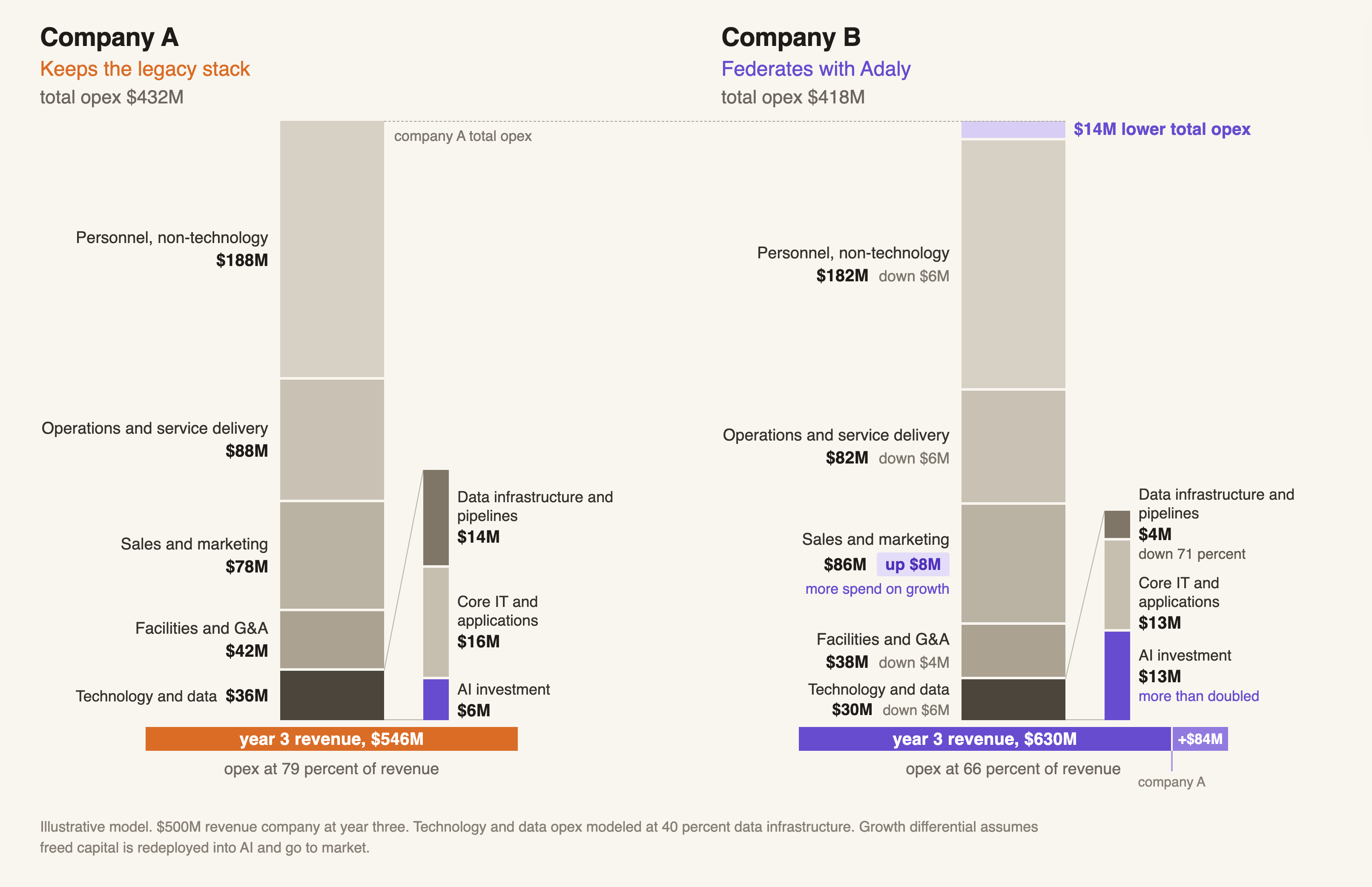
Company A points models at a warehouse full of copies. Every question requires assembling context from four systems that disagree. Every answer needs a person to verify it. Every verification burns more tokens. They pay three times over for one correct answer, and they still get it late.
Company B has clean, live, governed access to every system at the moment of the query. One call. Current values. No reconciliation. Their cost per correct answer is a fraction of Company A's, so they can put agents on work Company A cannot justify.
Same models. Same token prices. Completely different unit economics.
What separates them is data architecture, decided years before anyone in the building said the word "agent."
Do the arithmetic on your own P&L
Take a $500 million revenue company at 6 percent IT. That is $30 million. Say the data program is $12 million of it, which is conservative for most enterprises I talk to.
We give back roughly 70 percent of that number. Call it $8.4 million a year. Not once. Every year.
We do it while increasing functionality, which is the part people do not believe until they see it. There is no compromise where you trade capability for savings. You get faster access to more systems with governance you did not have before.
Three years of that is $25 million in freed capital.
Ask yourself what a competitor does with $25 million you do not have. They fund an AI program properly instead of running pilots on scraps. They buy the talent. They ship four things while you ship one. They can afford to be wrong twice and still be ahead, because losing is cheap when your cost base is lower.
That is the capital war. It is being fought right now, in budget meetings, by people who think they are discussing infrastructure.
Fix your IT budgets by inverting your data program bdugets and AI budgets by using Adaly and you're still generating a net opex savings in your IT budget. You're rapidly deploying applications, automations, and being smarter so IT is checking off internal stakeholder backlog items faster than ever before while also taking the net opex savings and putting them into growth areas such as marketing and sales (though AI could also be a growth lever supporting those areas too - depends how your finances are managed).
The smart companies who get this are the ones that are going to blow past their competitors and it's not going to be noticed until it's too late.
Why we built Adaly this way
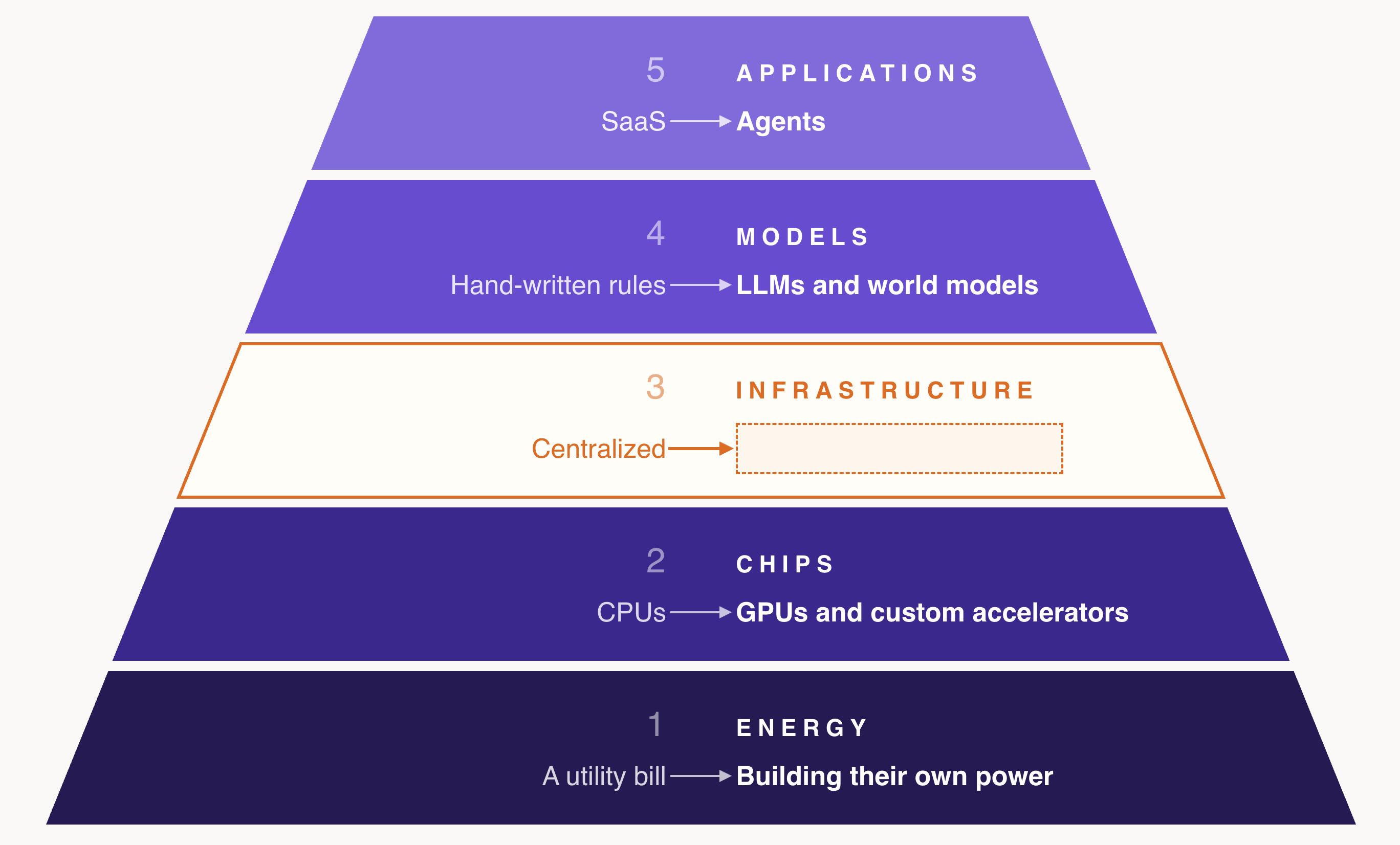
We built Adaly on one idea. Centralizing data before you use it was a workaround for constraints that no longer exist, and the copy tax now costs more than the problem it solved.
Adaly connects to systems at full depth. Not surface level API stubs that read a few objects and call it an integration. Full depth, which is why we replace the warehouse instead of sitting on top of it and adding another line to your bill. Single source of definition. Live values at query time. Nothing copied, so nothing drifts.
Above that sits a layer that understands the relationships in your data and builds an ontology from how the business actually works. That is what makes a model useful inside your company instead of impressive in a demo.
The result is a smaller data program, a lower cost per query, and an AI capability that works because the data underneath it is real.
The part that should keep you up
Capital disadvantage does not announce itself.
You will not feel it this quarter. Your numbers will look fine. The competitor gaining on you will not send a press release. You will feel it in about two years, when a company you used to beat is launching faster, pricing lower, and hiring people you wanted, and you cannot work out how they are affording it.
They are affording it because they stopped paying the copy tax while you were still budgeting for next year's pipeline refresh.
The window on this is not five years. Cloud waste is going up. AI bills are going up. The gap between the companies that fixed their foundation and the ones that did not is compounding every quarter.
If you are running a data program today and you cannot tell me what percentage of it exists purely to move your own data from one place to another, that is where I would start. The number is usually higher than anyone expects, and it is the most recoverable money on your P&L.
We should talk before your next budget cycle, not after it.











Want it from the source?
Every transmission above is on the record. For interviews, statements, or anything the wire has not carried yet, talk to the people who said it.